
Impact of a Nationwide Notification Promoting Early Adrenaline Administration on Time to First Adrenaline in Out-of-Hospital Cardiac Arrest in Japan An Interrupted Time-Series Analysis
Article Sidebar
Main Article Content
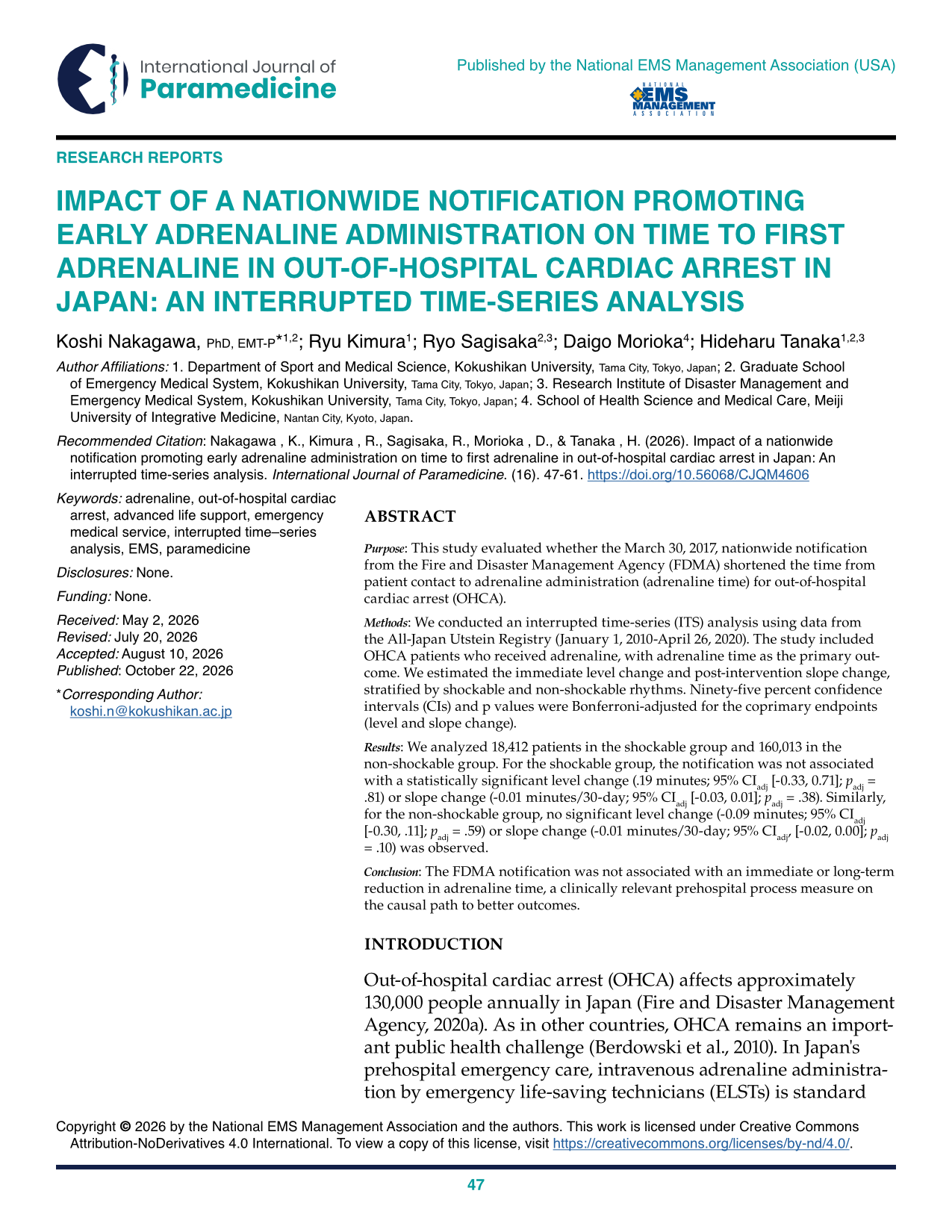
Abstract
Purpose: This study evaluated whether the March 30, 2017, nationwide notification from the Fire and Disaster Management Agency (FDMA) shortened the time from patient contact to adrenaline administration (adrenaline time) for out-of-hospital cardiac arrest (OHCA).
Methods: We conducted an interrupted time-series (ITS) analysis using data from the All-Japan Utstein Registry (January 1, 2010-April 26, 2020). The study included OHCA patients who received adrenaline, with adrenaline time as the primary outcome. We estimated the immediate level change and post-intervention slope change, stratified by shockable and non-shockable rhythms. Ninety-five percent confidence intervals (CIs) and p values were Bonferroni-adjusted for the coprimary endpoints (level and slope change).
Results: We analyzed 18,412 patients in the shockable group and 160,013 in the non-shockable group. For the shockable group, the notification was not associated with a statistically significant level change (.19 minutes; 95% CIadj [-0.33, 0.71]; padj = .81) or slope change (-0.01 minutes/30-day; 95% CIadj [-0.03, 0.01]; padj = .38). Similarly, for the non-shockable group, no significant level change (-0.09 minutes; 95% CIadj [-0.30, .11]; padj = .59) or slope change (-0.01 minutes/30-day; 95% CIadj, [-0.02, 0.00]; padj = .10) was observed.
Conclusion: The FDMA notification was not associated with an immediate or long-term reduction in adrenaline time, a clinically relevant prehospital process measure on the causal path to better outcomes.
Article Details

This work is licensed under a Creative Commons Attribution-NoDerivatives 4.0 International License.
Publishing in IJOP allows authors to keep their copyright while giving IJOP unrestricted copyright permissions. Articles published in IJOP use Creative Common Attribution 4.0 International (CC BY-ND 4.0) licensing. This license requires that re-users give credit to the creator. It allows re-users to copy and distribute the material in any medium or format in unadapted form only, even for commercial purposes. Additional terms apply and can be accessed here.
Publishing in IJOP also allows authors to have contracts for non-exclusive distribution of the Journal's published version of the article, such as posting to an institutional repository or publication in a book, on the condition that the original publication in the original layout format in IJOP is retained and acknowledged.
We permit and encourage authors to post the articles they published in IJOP on their affiliated websites. This helps share the information, encourages citation in other works, and promotes scholarly discourse in the spirit of open access.
References
Aichi Council for the Advancement of Ambulance Services [Aichi Prefectural Medical Control Council]. (n.d.). Aichi Prefecture ambulance cardiopulmonary resuscitation protocol and pre-cardiac-arrest protocol (16th ed.) [in Japanese]. Nagoya, Japan: The Council. (Internal protocol document maintained by the prefectural medical control council; not publicly distributed.)
Alarcon Falconi, T. M., Estrella, B., Sempértegui, F., & Naumova, E. N. (2020). Effects of data aggregation on time series analysis of seasonal infections. International Journal of Environmental Research and Public Health, 17(16), Article 5887. https://doi.org/10.3390/ijerph17165887
Berdowski, J., Berg, R. A., Tijssen, J. G. P., & Koster, R. W. (2010). Global incidences of out-of-hospital cardiac arrest and survival rates: Systematic review of 67 prospective studies. Resuscitation, 81(11), 1479-1487. https://doi.org/10.1016/j.resuscitation.2010.08.006
Bhaskaran, K., Gasparrini, A., Hajat, S., Smeeth, L., & Armstrong, B. (2013). Time series regression studies in environmental epidemiology. International Journal of Epidemiology, 42(4), 1187-1195. https://doi.org/10.1093/ije/dyt092
Fire and Disaster Management Agency. (2017). On the ambulance activity protocol based on the JRC Resuscitation Guidelines 2015 (Ambulance Planning Division Notice No. 41) [in Japanese]. https://www.fdma.go.jp/laws/tutatsu/assets/290330_kyu41.pdf
Fire and Disaster Management Agency. (2020a). Current status of ambulance and rescue services, Reiwa 2 (2020) edition [Status of EMS and fire rescue; in Japanese]. https://www.fdma.go.jp/publication/rescue/post-2.html
Fire and Disaster Management Agency. (2020b). Response by fire departments to cardiopulmonary arrest patients and those suspected of COVID-19 infection (Ambulance Planning Division Notice) [in Japanese]. https://www.fdma.go.jp/laws/tutatsu/items/200427_kyuki_1.pdf
Fonarow, G. C., Smith, E. E., Saver, J. L., Reeves, M. J., Hernandez, A. F., Peterson, E. D., Sacco, R. L., & Schwamm, L. H. (2011). Improving door-to-needle times in acute ischemic stroke: The design and rationale for the American Heart Association/American Stroke Association's Target: Stroke initiative. Stroke, 42(10), 2983-2989. https://doi.org/10.1161/STROKEAHA.111.621342
Haywood, K. L., Ji, C., Quinn, T., Nolan, J. P., Deakin, C. D., Scomparin, C., Lall, R., Gates, S., Long, J., Regan, S., Fothergill, R. T., Pocock, H., Rees, N., O'Shea, L., & Perkins, G. D. (2021). Long term outcomes of participants in the PARAMEDIC2 randomised trial of adrenaline in out-of-hospital cardiac arrest. Resuscitation, 160, 84-93. https://doi.org/10.1016/j.resuscitation.2021.01.019
Jacobs, I., Nadkarni, V., Bahr, J., Berg, R. A., Billi, J. E., Bossaert, L., Cassan, P., Coovadia, A., D'Este, K., Finn, J., Halperin, H., Handley, A., Herlitz, J., Hickey, R., Idris, A., Kloeck, W., Larkin, G. L., Mancini, M. E., Mason, P., . . . Zideman, D. (2004). Cardiac arrest and cardiopulmonary resuscitation outcome reports: Update and simplification of the Utstein templates for resuscitation registries: A statement for healthcare professionals from a task force of the International Liaison Committee on Resuscitation. Circulation, 110(21), 3385-3397. https://doi.org/10.1161/01.CIR.0000147236.85306.15
Jandoc, R., Burden, A. M., Mamdani, M., Lévesque, L. E., & Cadarette, S. M. (2015). Interrupted time series analysis in drug utilization research is increasing: Systematic review and recommendations. Journal of Clinical Epidemiology, 68(8), 950-956. https://doi.org/10.1016/j.jclinepi.2014.12.018
Japan Resuscitation Council. (2016). JRC resuscitation guidelines 2015: Adult advanced life support [in Japanese]. Igaku-Shoin.
Japan Resuscitation Council. (2021). JRC sosei gaidorain 2020: Seijin niji kyumei shochi [JRC resuscitation guidelines 2020: Adult advanced life support]. Igaku-Shoin. [in Japanese]
Kitagawa, Y., & Saito, H. (2018). Aichi-ken ni okeru medikaru kontororu taisei no genjo ni tsuite [Current status of the medical control system in Aichi Prefecture] [Conference presentation; in Japanese]. FY2018 National Medical Control Council Liaison Conference, Fire and Disaster Management Agency, Tokyo, Japan. https://www.fdma.go.jp/singi_kento/kento/items/kento233_03_shiryo-2.pdf
Kontopantelis, E., Doran, T., Springate, D. A., Buchan, I., & Reeves, D. (2015). Regression based quasi-experimental approach when randomisation is not an option: Interrupted time series analysis. BMJ, 350, h2750. https://doi.org/10.1136/bmj.h2750
Lopez Bernal, J., Cummins, S., & Gasparrini, A. (2017). Interrupted time series regression for the evaluation of public health interventions: A tutorial. International Journal of Epidemiology, 46(1), 348-355. https://doi.org/10.1093/ije/dyw098
Lopez Bernal, J., Cummins, S., & Gasparrini, A. (2018). The use of controls in interrupted time series studies of public health interventions. International Journal of Epidemiology, 47(6), 2082-2093. https://doi.org/10.1093/ije/dyy135
Nakagawa, K., Sagisaka, R., Saito, S., Miyako, J., Takyu, H., & Tanaka, H. (2023). The association of adrenaline administration time and neurological outcomes in Japan: A multilevel model analysis [in Japanese]. Japanese Journal of Reanimatology, 42(1), 7-15. https://doi.org/10.11414/jjreanimatology.42.1_7
Okada, Y., Nakagawa, K., Tanaka, H., Takahashi, H., Kitamura, T., Kiguchi, T., Nishioka, N., Kitamura, N., Tagami, T., Inoue, A., Hifumi, T., Sakamoto, T., Kuroda, Y., & Iwami, T. (2024). Overview and future prospects of out-of-hospital cardiac arrest registries in Japan. Resuscitation Plus, 17, 100578. https://doi.org/10.1016/j.resplu.2024.100578
Okubo, M., Komukai, S., Callaway, C. W., & Izawa, J. (2021). Association of timing of epinephrine administration with outcomes in adults with out-of-hospital cardiac arrest. JAMA Network Open, 4(8), e2120176. https://doi.org/10.1001/jamanetworkopen.2021.20176
Penfold, R. B., & Zhang, F. (2013). Use of interrupted time series analysis in evaluating health care quality improvements. Academic Pediatrics, 13(6 Suppl), S38-S44. https://doi.org/10.1016/j.acap.2013.08.002
Perkins, G. D., Ji, C., Deakin, C. D., Quinn, T., Nolan, J. P., Scomparin, C., Regan, S., Long, J., Slowther, A., Pocock, H., Black, J. J. M., Moore, F., Fothergill, R. T., Rees, N., O'Shea, L., Docherty, M., Gunson, I., Han, K., Charlton, K., . . . Lall, R. (2018). A randomized trial of epinephrine in out-of-hospital cardiac arrest. New England Journal of Medicine, 379(8), 711-721. https://doi.org/10.1056/NEJMoa1806842
Ran, L., Liu, J., Tanaka, H., Hubble, M. W., Takyu, H., & Huang, W. (2020). Early administration of adrenaline for out-of-hospital cardiac arrest: A systematic review and meta-analysis. Journal of the American Heart Association, 9(11), e014330. https://doi.org/10.1161/JAHA.119.014330
Ueta, H., Tanaka, H., Takyu, H., Sagisaka, R., Tanaka, S., Higuchi, T., Akihama, H., Takahashi, H., Kinoshi, T., & Sakanashi, S. (2023). Improvement in regional disparities in prehospital emergency medical care systems using the prehospital care index: How the timing of adrenaline administration by paramedics impacts cerebral functioning prognosis. Journal of EMS Medicine, 2(1), 31-38. https://doi.org/10.35616/jemsm.2021.00080
Wagner, A. K., Soumerai, S. B., Zhang, F., & Ross-Degnan, D. (2002). Segmented regression analysis of interrupted time series studies in medication use research. Journal of Clinical Pharmacy and Therapeutics, 27(4), 299-309. https://doi.org/10.1046/j.1365-2710.2002.00430.x
World Health Organization. (2020, January 5). Pneumonia of unknown cause – China. https://www.who.int/emergencies/disease-outbreak-news/item/2020-DON229