
Qualitative Investigation of EMS Provider Experiences with a Flow-Regulating Safety Device for Manual Ventilation A Preliminary Report
Article Sidebar
Main Article Content
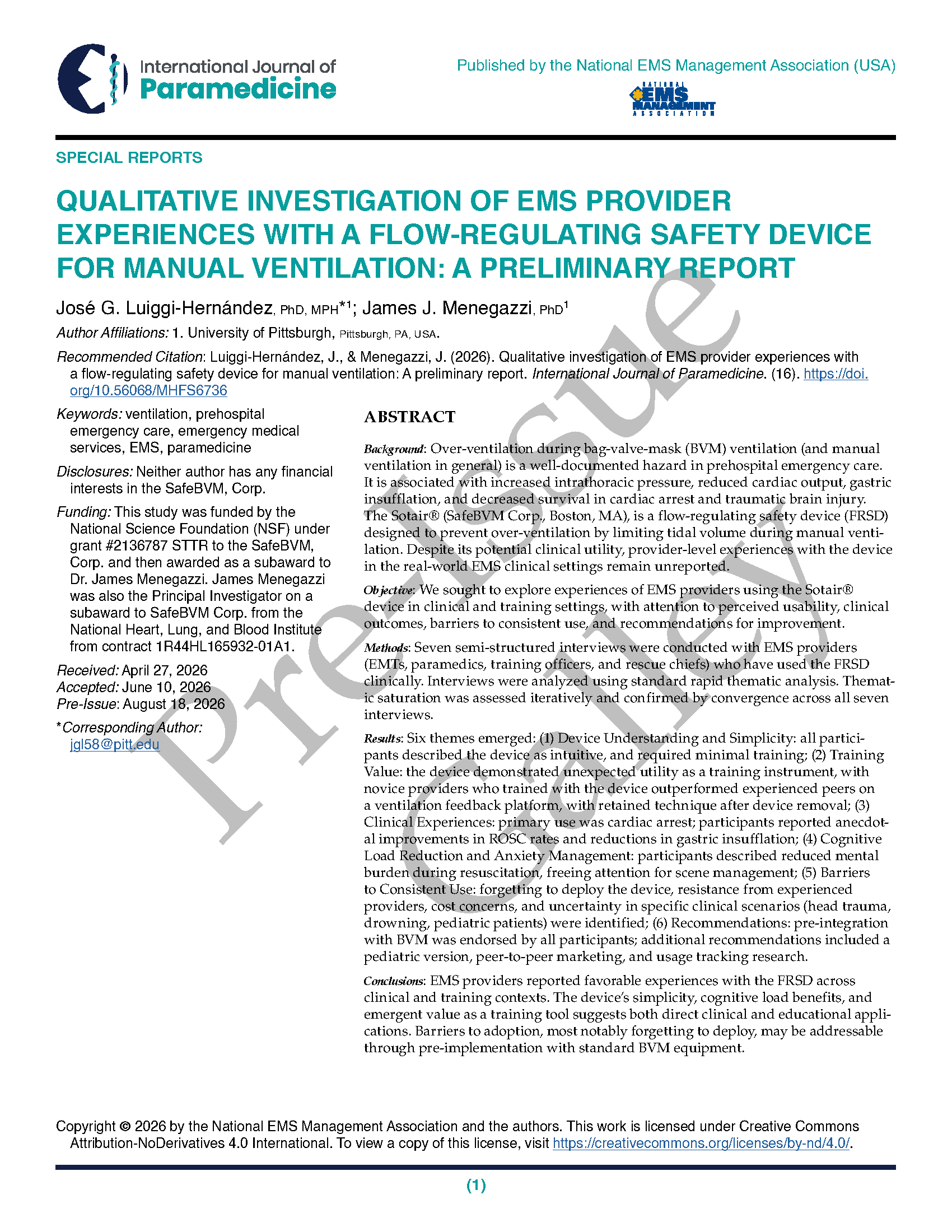
Abstract
Background: Over-ventilation during bag-valve-mask (BVM) ventilation (and manual ventilation in general) is a well-documented hazard in prehospital emergency care. It is associated with increased intrathoracic pressure, reduced cardiac output, gastric insufflation, and decreased survival in cardiac arrest and traumatic brain injury. The Sotair® (SafeBVM Corp., Boston, MA), is a flow-regulating safety device (FRSD) designed to prevent over-ventilation by limiting tidal volume during manual ventilation. Despite its potential clinical utility, provider-level experiences with the device in the real-world EMS clinical settings remain unreported.
Objective: We sought to explore experiences of EMS providers using the Sotair® device in clinical and training settings, with attention to perceived usability, clinical outcomes, barriers to consistent use, and recommendations for improvement.
Methods: Seven semi-structured interviews were conducted with EMS providers (EMTs, paramedics, training officers, and rescue chiefs) who have used the FRSD clinically. Interviews were analyzed using standard rapid thematic analysis. Thematic saturation was assessed iteratively and confirmed by convergence across all seven interviews.
Results: Six themes emerged: (1) Device Understanding and Simplicity: all participants described the device as intuitive, and required minimal training; (2) Training Value: the device demonstrated unexpected utility as a training instrument, with novice providers who trained with the device outperformed experienced peers on a ventilation feedback platform, with retained technique after device removal; (3) Clinical Experiences: primary use was cardiac arrest; participants reported anecdotal improvements in ROSC rates and reductions in gastric insufflation; (4) Cognitive Load Reduction and Anxiety Management: participants described reduced mental burden during resuscitation, freeing attention for scene management; (5) Barriers to Consistent Use: forgetting to deploy the device, resistance from experienced providers, cost concerns, and uncertainty in specific clinical scenarios (head trauma, drowning, pediatric patients) were identified; (6) Recommendations: pre-integration with BVM was endorsed by all participants; additional recommendations included a pediatric version, peer-to-peer marketing, and usage tracking research.
Conclusions: EMS providers reported favorable experiences with the FRSD across clinical and training contexts. The device’s simplicity, cognitive load benefits, and emergent value as a training tool suggests both direct clinical and educational applications. Barriers to adoption, most notably forgetting to deploy, may be addressable through pre-implementation with standard BVM equipment.
Article Details

This work is licensed under a Creative Commons Attribution-NoDerivatives 4.0 International License.
Publishing in IJOP allows authors to keep their copyright while giving IJOP unrestricted copyright permissions. Articles published in IJOP use Creative Common Attribution 4.0 International (CC BY-ND 4.0) licensing. This license requires that re-users give credit to the creator. It allows re-users to copy and distribute the material in any medium or format in unadapted form only, even for commercial purposes. Additional terms apply and can be accessed here.
Publishing in IJOP also allows authors to have contracts for non-exclusive distribution of the Journal's published version of the article, such as posting to an institutional repository or publication in a book, on the condition that the original publication in the original layout format in IJOP is retained and acknowledged.
We permit and encourage authors to post the articles they published in IJOP on their affiliated websites. This helps share the information, encourages citation in other works, and promotes scholarly discourse in the spirit of open access.
References
Braun, V. & Clarie, V. (2021). Thematic Analysis: A Practical Guide. Sage.
Carlson, J. N., Colella, M. R., Daya, M. R., De Maio, V. J., Nawrocki, P., Nikolla, D. A., & Bosson, N. (2022). Prehospital cardiac arrest airway management: An NAEMSP position statement and resource document. Prehospital Emergency Care, 26, 54-63. https://doi.org/10/1080/10903127.2021.1971349
Guest, G., Bunce, A., & Johnson, L. (2006). How many interviews are enough? An experiment with data saturation and variability. Field Methods, 18(1), 59-82. http://doi.org/10/1177/1525822X05279903
Keinman, M. E., Buick, J. E., Huber, N., Idris, A. H., Levy, M., Morgan, S. G., Nassal, M. M. J., & Nassal, M. M. R. (2025). Part 7: Adult basic life support: 2025 American Heart Association guidelines for cardiopulmonary resuscitation and emergency cardiovascular care. Circulation, 152, S44-S478. https://doi.org/10.1161/CIR.0000000000001360
Leonard, J. C., Scharff, D. P., Koors, V., Brooke, Lerner, E., Adelgais, K. M., Anders, J., Brown, K., Babcock, L., & Jaffe, D. M. (2012). A qualitative assessment of factors that influence emergency medical services partnerships in prehospital research. Academic Emergency Medicine, 19(2), 161-173. https://doi.org/10.1111/j.1553-2712.2011.01283.x
Lyng., J. W., Guyette, F. X., Levy, M. & Bosson, N. (2022). Prehospital manual ventilation: An NAEMSP position statement and resource document. Prehospital Emergency Care, 26, 23-31. https://doi.org/10.1080/10903127.2021.1981506
Malterud, K. Siersma, V. D., & Guassora, A. D. (2016). Sample size in qualitative interview studies: Guided by information power. Qualitative Health Research, 26(13), 1753-1760. https://doi.org/10.1177/1049732315617444
Nevedal, A. L. Reardon, C. M., Opra Widerquist, M. A., Jackson, G. L., Cutrona, S. L., White, B. S., & Damschroder, L. J. (2021). Rapid versus traditional qualitative analysis using the Consolidated Framework for Implementation Research (CFIR). Implementation Science, 16(1) Article 67. https://doi.org/10.1186/s13012-021-01111-5
Newington, L. & Metcalfe, A. (2014). Factors influencing recruitment to research: Qualitative study of the experience and perceptions of research teams. BMC Medical Research Methodology, 14, Article 10. https://doi.org/10.1186/1471-2288-14-10
Smyth, M. A., van Goor, S., Hansen, C. M., Fijacko, N., Nakagawa, N. K., Raffay, V., Ristagno, G., Rogers, J., & ERC Adult Basic Life Support Collaborators (2025). European Resuscitation Counsil guidelines 2025: Adult basic life support. Resuscitation, 215(Suppl. 1), Article 110771. https://doi.org/10/1016/j.resuscitation.2025.110771
White, L. A., Conrad, S. A., & Alexander, J. S., (2024). Pathophysiology and prevention of manual-ventilation-induced lung injury (MVILI). Pathophysiology, 31(4), 583-595. https://doi.org/10.3390/pathophysiology31040042