
Perceptions and Expectations of Academic Knowledge in Swiss Paramedicine (SWISS PEAK) A National Cross-Sectional Survey of EMS Professionals
Article Sidebar
Main Article Content
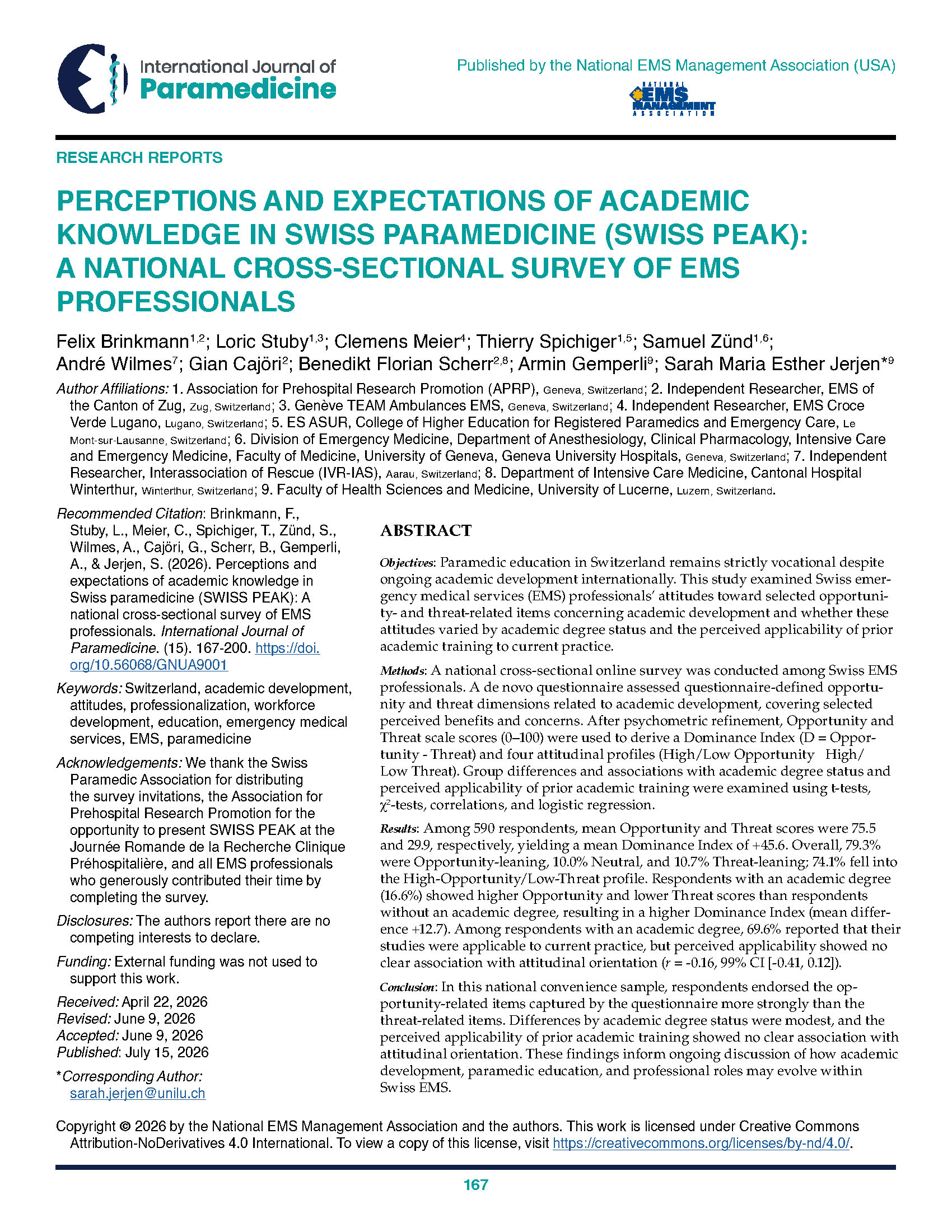
Abstract
Objectives: Paramedic education in Switzerland remains vocational despite ongoing academic development internationally. This study examined Swiss emergency medical services (EMS) professionals’ attitudes toward opportunity- and threat-related items concerning academic development and whether these attitudes varied by academic degree status and the perceived applicability of prior academic training to current practice.
Methods: A national cross-sectional online survey was conducted among Swiss EMS professionals. A de novo questionnaire assessed questionnaire-defined opportunity and threat dimensions related to academic development, covering selected perceived benefits and concerns. After psychometric refinement, Opportunity and Threat scale scores (0–100) were used to derive a Dominance Index (D = Opportunity - Threat) and four attitudinal profiles (High/Low Opportunity × High/Low Threat). Group differences and associations with academic degree status and perceived applicability of prior academic training were examined using t-tests, χ²-tests, correlations, and logistic regression.
Results: Among 590 respondents, mean Opportunity and Threat scores were 75.5 and 29.9, respectively, yielding a mean Dominance Index of +45.6. Overall, 79.3% were Opportunity-leaning, 10.0% Neutral, and 10.7% Threat-leaning; 74.1% fell into the High-Opportunity/Low-Threat profile. Respondents with an academic degree (16.6%) showed higher Opportunity and lower Threat scores than respondents without an academic degree, resulting in a higher Dominance Index (mean difference +12.7). Among respondents with an academic degree, 69.6% reported that their studies were applicable to current practice, but perceived applicability showed no clear association with attitudinal orientation (r = -0.16, 99% CI [-0.41, 0.12]).
Conclusion: In this national convenience sample, respondents endorsed the opportunity-related items captured by the questionnaire more strongly than the threat-related items. Differences by academic degree status were modest, and the perceived applicability of prior academic training showed no clear association with attitudinal orientation. These findings inform ongoing discussion of how academic development, paramedic education, and professional roles may evolve within Swiss EMS.
Article Details

This work is licensed under a Creative Commons Attribution-NoDerivatives 4.0 International License.
Publishing in IJOP allows authors to keep their copyright while giving IJOP unrestricted copyright permissions. Articles published in IJOP use Creative Common Attribution 4.0 International (CC BY-ND 4.0) licensing. This license requires that re-users give credit to the creator. It allows re-users to copy and distribute the material in any medium or format in unadapted form only, even for commercial purposes. Additional terms apply and can be accessed here.
Publishing in IJOP also allows authors to have contracts for non-exclusive distribution of the Journal's published version of the article, such as posting to an institutional repository or publication in a book, on the condition that the original publication in the original layout format in IJOP is retained and acknowledged.
We permit and encourage authors to post the articles they published in IJOP on their affiliated websites. This helps share the information, encourages citation in other works, and promotes scholarly discourse in the spirit of open access.
References
Batt, A., Knox, S., Delport, S., & Acker, J. (2019). Degrees of change: Opportunities and obstacles for paramedic degree education. Canadian Paramedicine, 42(5), 11-14. https://www.researchgate.net/publication/334812106_Degrees_of_change_opportunities_and_obstacles_for_paramedic_degree_education
Bowles, K.-A., Batt, A. M., O’Toole, M., Knox, S., Hemingway, L., Williams, J., Williams, B., & Cummins, N. M. (2024). Identifying the essential elements to inform the development of a research agenda for paramedicine in Ireland: A Delphi study. Health Research Policy and Systems, 22(1), 100. https://doi.org/10.1186/s12961-024-01188-6
Brinkmann, F. (2024). Personalmarketing im Rettungswesen. Tectum Verlag. https://www.exlibris.ch/de/buecher-buch/deutschsprachige-buecher/felix-brinkmann/personalmarketing-im-rettungswesen/id/9783689001827/?srsltid=AfmBOorqo2DjR5yDwnVr_RIajoED2RyPcNi6ZUTKvG05q7aS5G6n0Dog
Bueter, A., & Jukola, S. (2025). Multi-professional healthcare teams, medical dominance, and institutional epistemic injustice. Medicine, Health Care, and Philosophy, 28(2), 219-232. https://doi.org/10.1007/s11019-025-10252-z
Catu, L. R. (2021). Nurses’ awareness, perceived knowledge, attitude towards and barriers in evidence-based practice (EBP). Journal of Health and Caring Sciences, 3, 3-17. https://doi.org/10.37719/jhcs.2021.v3i1.oa001
Cignacco, E., Schlenker, A., Amman-Fiechter, S., Damke, T., Labrusse, C. C. de, Krahl, A., Kalberer, B. S., & Weber-Käser, A. (2024). Advanced midwifery practice in Switzerland: Development and challenges. European Journal of Midwifery, 8(April), 1-7. https://doi.org/10.18332/ejm/185648
Coetsee, L. (1999). From Resistance to Commitment. Public Administration Quarterly, 23(2), 204-222. https://www.semanticscholar.org/paper/From-Resistance-to-Commitment-Coetsee/deabcdef17ad5a6a59b70b2bb2264c21b39a6a25
Cordrey, T., Thomas, A., King, E., & Gustafson, O. (2024). Evaluating the perceived impact and legacy of master’s degree level research in the allied health professions: A UK-wide cross-sectional survey. BMC Medical Education, 24(1), 750. https://doi.org/10.1186/s12909-024-05582-0
Corman, M., Phillips, P., & McCann, L. (2025). The future of paramedic education: Problematizing the translucent curriculum in paramedicine. Paramedicine. https://doi.org/10.1177/27536386251338525
DeVellis, R. F. (1991). Scale development: Theory and applications. Sage Publications. (1991-98125-000). https://research.ebsco.com/linkprocessor/plink?id=180851eb-06ea-3ec6-9a61-3d69b878a984
Dúason, S., Ericsson, C., Jónsdóttir, H. L., Andersen, J. V., & Andersen, T. L. (2021). European paramedic curriculum: A call for unity in paramedic education on a European level. Scandinavian Journal of Trauma, Resuscitation and Emergency Medicine, 29(1), 72. https://doi.org/10.1186/s13049-021-00889-z
Federal Statistical Office. (2025, October 13). Languages. Federal Population Census Structural Survey. https://www.bfs.admin.ch/content/bfs/en/home/statistics/population/languages-religions/languages.html
Feerick, F., Coughlan, E., Knox, S., Murphy, A., Grady, I. O., & Deasy, C. (2025). Barriers to paramedic professionalisation: A qualitative enquiry across the UK, Canada, Australia, USA and the republic of Ireland. BMC Health Services Research, 25(1), 993. https://doi.org/10.1186/s12913-025-13196-5
Feyereisen, S., McConnell, W., Thomas, C., & Puro, N. (2021). Physician dominance in the 21st century: Examining the rise of non-physician autonomy through prevailing theoretical lenses. Sociology of Health & Illness, 43(8), 1867-1886. https://doi.org/10.1111/1467-9566.13366
Givati, A., Markham, C., & Street, K. (2018). The bargaining of professionalism in emergency care practice: NHS paramedics and higher education. Advances in Health Sciences Education, 23(2), 353-369. https://doi.org/10.1007/s10459-017-9802-1
Gonon, P., & Bonoli, L. (2025). Two waves of academisation of VET in Switzerland: Threat or way forward? Nordic Journal of Vocational Education and Training, 15(1), 1100. https://doi.org/10.3384/njvet.2242-458X.25151100
Gottschalk, J., Jerrentrup, A., Plöger, B., Orendt, J., & Gnirke, A. (2024). Academic qualifications for emergency medical services personnel—Does it make sense? Notfall + Rettungsmedizin. https://doi.org/10.1007/s10049-024-01326-1
Hanson, A., & Burton, C. (2025). Knowledge translation in Anglo-American paramedicine: A scoping review. BMJ Open, 15(1), e087836. https://doi.org/10.1136/bmjopen-2024-087836
Hofmann, T. (2022). Studienintentionen deutscher Retter*innen. Notfall + Rettungsmedizin, 25(6), 424-426. https://doi.org/10.1007/s10049-022-00996-z
Interverband Rettungswesen. (2024). Kennzahlen Rettungswesen Personal. Interverband Rettungswesen. https://www.144.ch/kennzahlen-rettungswesen/personal
Makrides, T., Ross, L., Gosling, C., Acker, J., & O’Meara, P. (2022a). Defining two novel sub-models of the Anglo-American paramedic system: A Delphi study. Australasian Emergency Care, 25(3), 229-234. https://doi.org/10.1016/j.auec.2021.11.001
Makrides, T., Ross, L., Gosling, C., Acker, J., & O’Meara, P. (2022b). From stretcher bearer to practitioner: A brief narrative review of the history of the Anglo-American paramedic system. Australasian Emergency Care, 25(4), 347-353. https://doi.org/10.1016/j.auec.2022.05.001
Makrides, T., Smith, F., Ross, L., Gosling, C. M., Acker, J., & O’Meara, P. (2023). No two systems are the same: Paramedic perceptions of contemporary system performance using prehospital quality indicators. Cureus, 15(3), e35859. https://doi.org/10.7759/cureus.35859
Marung, H., Beckmann-Knoop, S., Beeck, S., Coban, I., Czerniejewski, A., Durek, V., Fehrs, T., Henschke, J., Heyduck, T., Krampe, T., Krühl, L., Kurz, P., Oldenburg, B., Paeslack, S., Päplow, J., Peters, M., Rühmann, F., Schäfer, L., Schulz, S., … Studierende der Kohorte Rescue Management Wintersemester 2023/24. (2025). Rettungsdienstbezogene Studiengänge in Deutschland. Notfall + Rettungsmedizin. https://doi.org/10.1007/s10049-025-01557-w
Nielsen, K. M., Nordgaard, J., & Henriksen, M. G. (2025). Fundamental issues in epistemic injustice in healthcare. Medicine, Health Care, and Philosophy, 28(2), 291-301. https://doi.org/10.1007/s11019-025-10259-6
Olaussen, A., Beovich, B., & Williams, B. (2021). Top 100 cited paramedicine papers: A bibliometric study. Emerg Med Australas., 33(6), 975-982. https://doi.org/10.1111/1742-6723.13774
O’Meara, P. (2011). So how can we frame our identity? Journal of Paramedic Practice, 3(2), 57. https://doi.org/10.12968/jpar.2011.3.2.57
O’Meara, P., Maguire, B., Jennings, P., & Simpson, P. (2015). Building an Australasian paramedicine research agenda: A narrative review. Health Research Policy and Systems, 13(1), 79. https://doi.org/10.1186/s12961-015-0065-0
Pap, R., Barr, N., Hutchison, A., O’Meara, P., Simpson, P., Reardon, M., Reeves, H., Reynolds, L., Thomson, M., & Ross, L. (2024). Research agenda and priorities for Australian and New Zealand paramedicine: A delphi consensus study. Paramedicine, 21(3), 94-107. https://doi.org/10.1177/27536386241231666
Reed, B., Cowin, L., O’Meara, P., & Wilson, I. (2019). Professionalism and professionalisation in the discipline of paramedicine. Australasian Journal of Paramedicine, 16, 1-10. https://doi.org/10.33151/ajp.16.715
Regener, H., & Trede, I. (2024). Berufsverbleib von Diplomierten Rettungssanitäterinnen und -sanitätern HF in der Schweiz. Notfall + Rettungsmedizin, 27(7), 531-536. https://doi.org/10.1007/s10049-024-01365-8
Runacres, J., Harvey, H., O’Brien, S., & Halck, A. (2024). Paramedics as researchers: A systematic review of paramedic perspectives of engaging in research activity from training to practice. The Journal of Emergency Medicine, 66(6), e680-e689. https://doi.org/10.1016/j.jemermed.2024.01.008
Schmutz, T., Guechi, Y., Denereaz, S., Ozainne, F., Nuoffer, M., Exadaktylos, A., & Ribordy, V. (2022). Paramedics in Switzerland: A mature profession. International Journal of Environmental Research and Public Health, 19(14), 8429. https://doi.org/10.3390/ijerph19148429
Toffel, K. (2020). An ambivalent recognition: The academisation of nursing in Switzerland. Professions and Professionalism, 10(3), 3813. https://doi.org/10.7577/pp.3813
von Elm, E., Altman, D., Egger, M., Pocock, S., Gøtzsche, P., & Vandenbroucke, J. (2007). Strengthening the reporting of observational studies in epidemiology (STROBE) statement: Guidelines for reporting observational studies. British Medical Journal, 335(7624), 806-808. https://doi.org/10.1136/bmj.39335.541782.AD
Vuilleumier, S., Fiorentino, A., Dénéréaz, S., & Spichiger, T. (2021). Identification of new demands regarding prehospital care based on 35,188 missions in 2018. BMC Emergency Medicine, 21(1), 63. https://doi.org/10.1186/s12873-021-00456-w
Willis, S. (2024). Paramedics with doctorates: Providing an original contribution to paramedic knowledge. International Journal for Advancing Practice, Comments, 2(1). https://doi.org/10.12968/ijap.2024.2.1.46
Xu, L., Tang, F., Wang, Y., Cai, Q., Tang, S., Xia, D., Xu, X., & Lu, X. (2021). Research progress of pre-hospital emergency during 2000-2020: A bibliometric analysis. American Journal of Translational Research, 13(3), 1109-1124. https://pmc.ncbi.nlm.nih.gov/articles/PMC8014387
Yalniz, N., Şenyuva, E., & Görügen, Ü. (2024). Professional values gained in postgraduate nursing education from the perspectives of master’s and doctorate graduates: A mixed-methods study. International Nursing Review, 71(4), 1100-1112. https://doi.org/10.1111/inr.12980
Zünd, S., Stuby, L., Suppan, L., Siebert, J. N., & Tinembart, J.-M. (2025). Impact of the first Swiss conference on prehospital emergency care and trauma research (SPECTRe) on paramedics’ intention to engage in research: Cross-sectional study. The Journal of Emergency Medicine, 74(1), 69-76. https://doi.org/10.1016/j.jemermed.2024.11.017