
Evaluating Potential Bias through Analyzing Patterns in Use of the ‘Smell of Alcohol’ in Prehospital Medicine Patients with Altered Mental Status across Various Demographic Groups
Article Sidebar
Main Article Content
Abstract
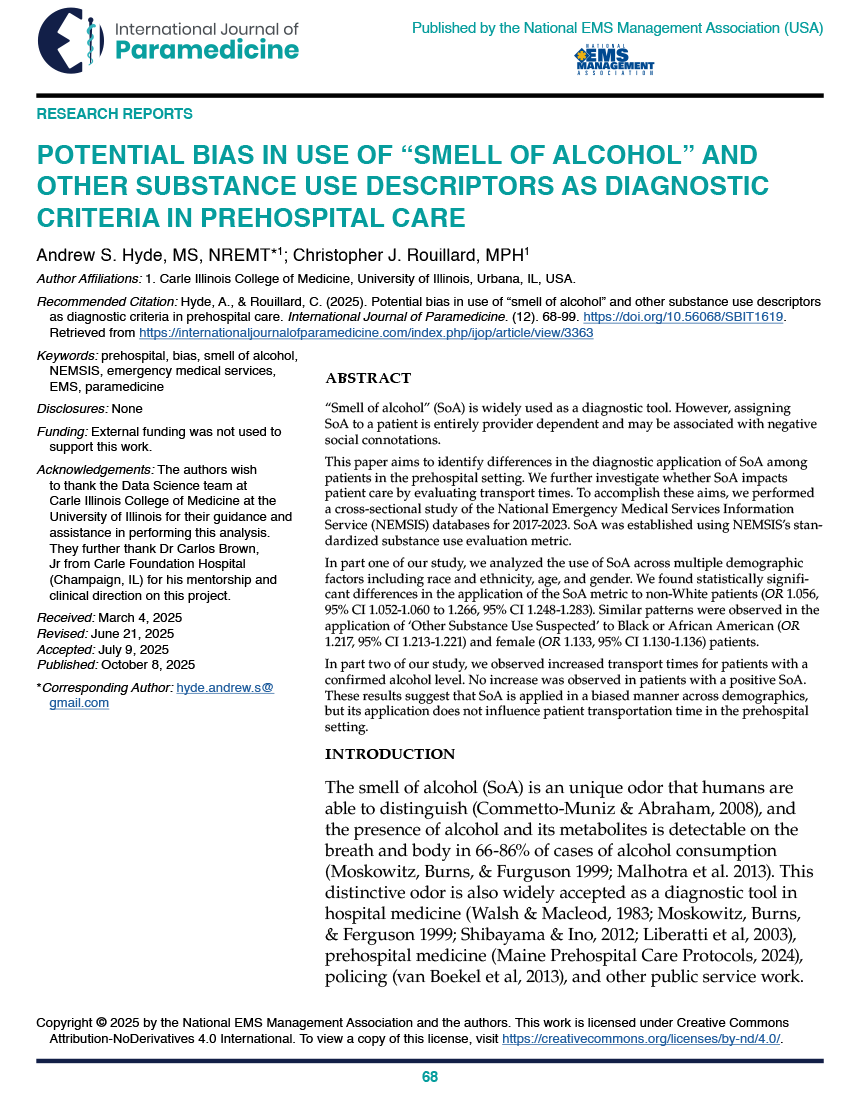
“Smell of alcohol” (SoA) is widely used as a diagnostic tool. However, assigning SoA to a patient is entirely provider dependent and may be associated with negative social connotations.
This paper aims to identify differences in the diagnostic application of SoA among patients in the prehospital setting. We further investigate whether SoA impacts patient care by evaluating transport times. To accomplish these aims, we performed a cross-sectional study of the National Emergency Medical Services Information Service (NEMSIS) databases for 2017-2023. SoA was established using NEMSIS’s standardized substance use evaluation metric.
In part one of our study, we analyzed the use of SoA across multiple demographic factors including race and ethnicity, age, and gender. We found statistically significant differences in the application of the SoA metric to non-White patients (OR 1.056, 95% CI 1.052-1.060 to 1.266, 95% CI 1.248-1.283). Similar patterns were observed in the application of ‘Other Substance Use Suspected’ to Black or African American (OR 1.217, 95% CI 1.213-1.221) and female (OR 1.133, 95% CI 1.130-1.136) patients.
In part two of our study, we observed increased transport times for patients with a confirmed alcohol level. No increase was observed in patients with a positive SoA. These results suggest that SoA is applied in a biased manner across demographics, but its application does not influence patient transportation time in the prehospital setting.
Article Details

This work is licensed under a Creative Commons Attribution-NoDerivatives 4.0 International License.
Publishing in IJOP allows authors to keep their copyright while giving IJOP unrestricted copyright permissions. Articles published in IJOP use Creative Common Attribution 4.0 International (CC BY-ND 4.0) licensing. This license requires that re-users give credit to the creator. It allows re-users to copy and distribute the material in any medium or format in unadapted form only, even for commercial purposes. Additional terms apply and can be accessed here.
Publishing in IJOP also allows authors to have contracts for non-exclusive distribution of the Journal's published version of the article, such as posting to an institutional repository or publication in a book, on the condition that the original publication in the original layout format in IJOP is retained and acknowledged.
We permit and encourage authors to post the articles they published in IJOP on their affiliated websites. This helps share the information, encourages citation in other works, and promotes scholarly discourse in the spirit of open access.
References
Brunson, D.C., Miller, K.A., Matheson, L.W., & Carrillo, E. (2023). Race and ethnicity and prehospital use of opioid or ketamine analgesia in acute traumatic injury. JAMA Network Open, 6(10), e2338070. https://doi.org/10.1001/jamanetworkopen.2023.38070
Commetto-Muniz, J.E, & Abraham, M.H (2008). Human olfactory detection of homologous n-alcohols measured via concentration-response functions. Pharmacology Biochemistry and Behavior, 89(3), 279–291. https://doi.org/10.1016/j.pbb.2007.12.023
Crowe, R.P., Kennel, J., Fernandez, A.R., Burton, B.A., Wang, H.E., Van Vleet, L., Bourn, S.S., & Myers, J.B. (2023). Racial, ethnic, and socioeconomic disparities in out-of-hospital pain management for patients with long bone fractures. (2023). Annals of Emergency Medicine, 82(5), 535-545. https://doi.org/10.1016/j.annemergmed.2023.03.035
Dalton M.K., Semco R.S., Ordoobadi A.J., Goralnick E., Chovanes J., Salim A., & Jarman M.P. (2022). Opioid administration in the prehospital setting for patients sustaining traumatic injuries: An evaluation of national emergency medical services data. Injury, 53(9), 2923-2929. https://doi.org/10.1016/j.injury.2022.03.068
Delker E., Brown Q., Hasin D.S. (2016). Alcohol consumption in demographic subpopulations: An epidemiologic overview. Alcohol Research Current Reviews, 38(1), 7-15. https://pmc.ncbi.nlm.nih.gov/articles/PMC4872616/
Dickason, R.M., Chauhan, V., Mor, A., Ibler, E., Kuehnle, S., Mahoney, D., Armbrecht, E., & Dalawari, P. (2015). Racial differences in opiate administration for pain relief at an academic emergency department. West Journal of Emergency Medicine: Integrating Emergency Care with Population Health, 16(3), 372-80. https://doi.org/10.5811/westjem.2015.3.23893
Elkbuil, A., Boserup, B., Sen-Crowe, B., Autrey, C., & McKenny, M. (2021). Effects of mode and time of EMS transport on the rate and distribution of dead on arrival among trauma population transported to ACSCOT-verified trauma centers in the United States. American Journal of Emergency Medicine, 50, 264-269. https://doi.org/10.1016/j.ajem.2021.08.035
Farcas, A.M., Joiner, A.P., Rudman, J.S., Ramesh, K., Torres, G., Crowe, R.P., Tripp, R., Bowers, K., von Isenburg, M. Logan, R., Coaxum, L., Salazar, G., Lozano Jr, M., Paige, D., Haamid, A. (2023). Disparities in emergency medical services care delivery in the United States: a scoping review. Prehospital Emergency Care, 27(8), 1058-1071. https://doi.org/10.1080/10903127.2022.2142344
Goldenberg, Keren. (2016, August 1). Talk to your teenager about breathalyzers even if they don’t drive. https://kgdefenselaw.com/2016/08/01/talk-to-your-teenager-about-breathalyzers/#:~:text=If%20your%20teenager%20arrives%20to,to%20this%20type%20of%20testing
Gopal, D.P., Chetty, U., O’Donnell, P., Gajria, C., & Blackadder-Weinstein, J. (2021). Implicit bias in healthcare: clinical practice, research and decision-making. Future Healthcare Journal, 8(1), 40-48. https://doi.org/10.7861/fhj.2020-0233
Hanchate, A.D., Paasche-Orlow, M.K., Baker, W.E., Lin, M., Banerjee, S., & Feldman J. (2019). Association of race/ethnicity with emergency department destination of emergency medical services transport. JAMA Network Open, 2(9), e1910816. https://doi.org/10.1001/jamanetworkopen.2019.10816
Hwang, U., Richardson, L.D., Harris, B., & Morrison, R.S. (2010). The quality of emergency department pain care for older adult patients. Journal of the American Geriatrics Society, 58(11), 2122-8. https://doi.org/10.1111/j.1532-5415.2010.03152.x
Kennel J., Withers E., Parsons N., & Woo H. (2019). Racial/ethnic disparities in pain treatment: evidence from Oregon emergency medical services agencies. Medical Care, 57(12), 924-929. https://doi.org/10.1097/MLR.0000000000001208
Kerr, W.C., Ye, Y., Williams, E., Mulia, N., & Cherpitel, C.J. (2021). Trends and disparities in American Indian/Alaska Native unintentional injury mortality from 1999-2016. Injury Prevention, 27(5), 435-441. https://doi.org/10.1136/injuryprev-2020-043951
Liberatti C.L.B., de Andrade S.M., Soares D.A., & Matsuo T. (2003) Helmet use by motorcyclists injured in traffic accidents in Londrina, southern Brazil. Revista Panamericana de Salud Pública (Pan American Journal of Public Health), 13(1), 33-38. https://doi.org/10.1590/s1020-49892003000100005
Lu, W., Lopez-Castro, T., & Vu, T. (2023). Population-based examination of substance use disorders and treatment use among US young adults in the National Survey on Drug Use and Health, 2011-2019. Drug and Alcohol Dependence Reports, 8, 100181. https://doi.org/10.1016/j.dadr.2023.100181
Maine Emergency Medical Services (2024, January 31). Prehospital treatment protocols. https://www.maine.gov/ems/sites/maine.gov.ems/files/inline-files/2023-Maine-EMS-Protocols-20240124.pdf
Malhotra, S., Kasturi, K., Abdelhak, N., Paladino, L., & Sinert, R (2013). The accuracy of the olfactory sense in detecting alcohol intoxication in trauma patients. Emergency Medicine Journal, 30(11), 923-925. https://doi.org/10.1136/emermed-2012-201548
Marcelin, J., Siraj, D.S., Victor, R., & Kotadia, S. The impact of unconscious bias in healthcare: how to recognize it and mediate it. The Journal of Infectious Diseases, 220(2), S62-S73. https://doi.org/10.1093/infdis/jiz214
McCoy, C.E., Menchine, M., Sampson, S., Anderson, C., & Khan, C. (2013) Emergency medical services out-of-hospital scene and transport times and their association with mortality in trauma patients presenting to an urban Level I trauma center. Annals of Emergency Medicine, 61(2), 167-174.
Mell, H.K., Mumma, S.N., & Hiestand, B. (2017). Emergency medical services response times in rural, suburban, and urban areas. JAMA Surgery, 152(10). 983-984. https://doi.org/10.1001/jamasurg.2017.2230
Moskowitz, H., Burns, M., & Ferguson, S. (1999). Police officers’ detection of breath odors from alcohol ingestion. Accident Analysis & Prevention, 31(3), 175-180. https://doi.org/10.1016/S0001-4575(98)00060-8
National Emergency Medical Services Information System (NEMSIS), Version 3.4. https://www.nemsis.org
NHTSA. (2025). Alcohol measurement devices. https://www.nhtsa.gov/book/countermeasures-that-work/alcohol-impaired-driving/countermeasures/enforcement/alcohol-measurement-devices#:~:text=Alcohol%20measurement%20devices%20are%20stationary,funds%20(NHTSA%2C%202021b)
Pack, C.E., Pertain, A.T., Crowe, R.P., & Brown, L.H. (2023). Ambulance transportation destinations in the US differ by patient race and ethnicity. Health Affairs, 42(2). https://doi.org/https://doi.org/10.1377/hlthaff.2022.00628
R Core Team. R: A language and environment for statistical computing. R Foundation for Statistical Computing. https://www.R-project.org/
Rahimi R.S., Elliott A.C., & Rockey D.C. (2013). Altered mental status in cirrhosis: etiologies and outcomes. Journal of Investigative Medicine, 61(4), 695-700. https://doi.org/10.2310/JIM.0b013e318289e254
Rothrock, S.G., Brandt, P., Godfrey, B., Silvestri, S., Pagane, J. (2001). Is there gender bias in the prehospital management of patients with acute chest pain? Prehospital Emergency Care, 5(4), 331-334. https://doi.org/10.1080/10903120190939454
Shibayama M., Cho T., & Ino A. (2012) Investigation of patients suspected of drinking, who visited emergency department, and their negative influence on emergency medical system. Nihon Arukoru Yakubutsu Igakkai Zasshi, 47(6), 331-340. https://pubmed.ncbi.nlm.nih.gov/23461221/
USDA. (2014, December 23). American Indians remain disproportionately rural. https://www.ers.usda.gov/data-products/chart-gallery/gallery/chart-detail/?chartId=77893#:~:text=Despite%20rapid%20increases%20in%20their,Rural%20and%20Small%2DTown%20America
van Boekel, L.C., Brouwers, E.P.M., van Weeghel, J., & Garretsen, H.F.L. (2013). Stigma among health professionals towards patients with substance use disorders and its consequences for healthcare delivery: systematic review. Drug and Alcohol Dependence, 131(1-2), 23-35. https://doi.org/10.1016/j.drugalcdep.2013.02.018
Vela, M.B., Erondu, A.I., Smith, N.A., Peek, M.E., Woodruff, J.M., & Chin, M.H. (2022). Eliminating explicit and implicit biases in health care: evidence and research needs. Annual Review of Public Health, 43, 477-501. https://doi.org/10.1146/annurev-publhealth-052620-103528
Vestal R.E., McGuire E.A., Tobin J.D., Andres R., Norris A.H., & Mezey E. (1977) Aging and ethanol metabolism. Clinical Pharmacology & Therapeutics, 21(3), 343-54. https://doi.org/10.1002/cpt1977213343
Walsh M.E., & Macleod A.D. (1983). Breath alcohol analysis in the accident and emergency department. Injury, 15(1), 62-66. https://doi.org/10.1016/0020-1383(83)90165-1
White, A.M. (2020). Gender differences in the epidemiology of alcohol use and related harms in the United States. Alcohol Research Current Reviews, 40(2), 01. https://doi.org/10.35946/arcr.v40.2.01
Yearby R., Clark B., & Figueroa, J. (2022). Structural racism in historical and modern US health care policy. Health Affairs, 41(2), 187-194. https://doi.org/10.1377/hlthaff.2021.01466