
Is Rurality Associated with Higher Probability of Conveyance to Hospital Following Diabetes-Related Ambulance Callouts? A Retrospective Observational Study
Article Sidebar
Main Article Content
Abstract
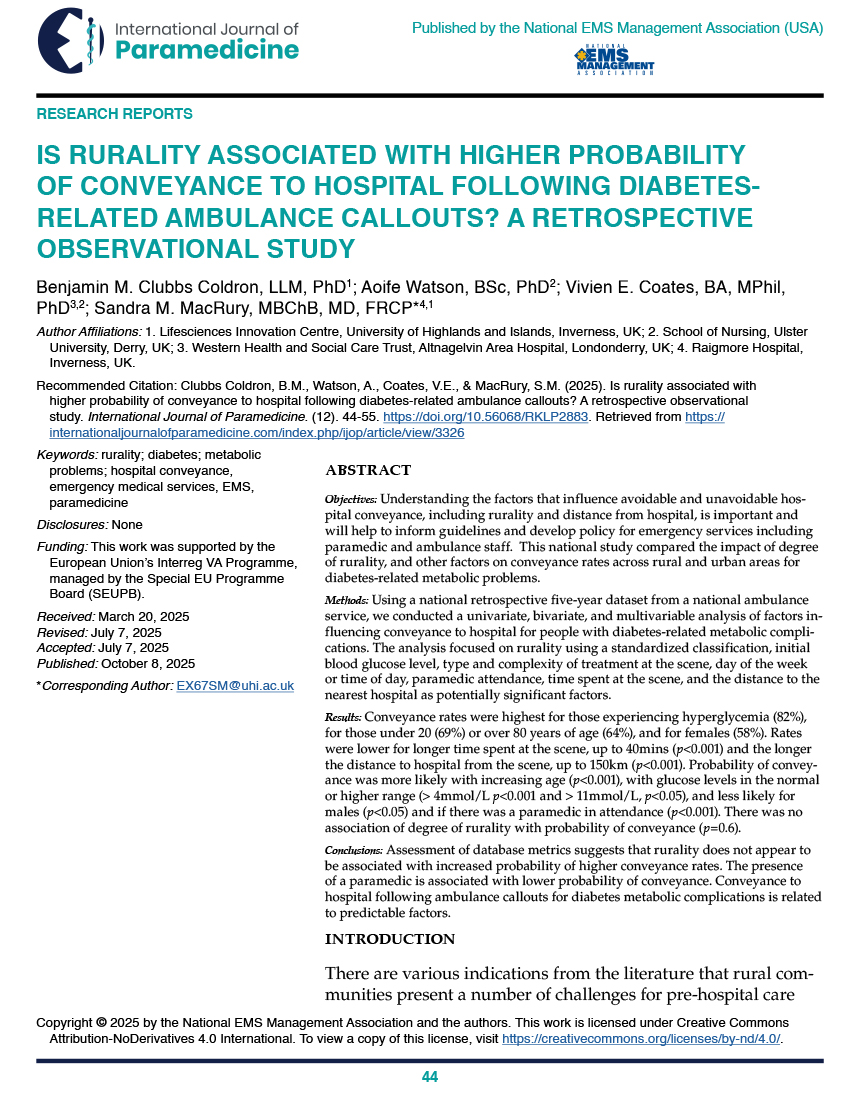
Objectives: Understanding the factors that influence avoidable and unavoidable hospital conveyance, including rurality and distance from hospital for diabetes-related metabolic problems is important and will help to inform guidelines and develop policy for emergency services including paramedic and ambulance staff. This study compared the impact of degree of rurality, and other factors on conveyance rates across rural and urban areas in Scotland.
Methods: Using a national retrospective five-year dataset from the Scottish Ambulance Service we conducted a univariate, bivariate and multivariable analysis of factors influencing conveyance to hospital for people with diabetes-related metabolic complications. The analysis focused on rurality using a national standardised classification, initial blood glucose level, type and complexity of treatment at the scene, day of the week or time of day, paramedic attendance, time spent at the scene and the distance to the nearest hospital as potentially significant factors.
Results: Conveyance rates were highest for those experiencing hyperglycaemia (82%), for those under 20yr (69%) or over 80yr (64%), and for females (58%). Rates were lower for longer time spent at the scene and the longer the distance to hospital from the scene. Probability of conveyance was more likely with increasing age, with glucose levels in the normal or higher range and less likely for males, and if there was a paramedic in attendance. There was no association of degree of rurality with probability of conveyance.
Conclusions: Conveyance to hospital following ambulance callouts for diabetes metabolic complications is related to predictable factors. The presence of a paramedic is associated with lower probability of conveyance. Rurality does not appear to be associated with increased probability of higher conveyance rates.
Article Details

This work is licensed under a Creative Commons Attribution-NoDerivatives 4.0 International License.
Publishing in IJOP allows authors to keep their copyright while giving IJOP unrestricted copyright permissions. Articles published in IJOP use Creative Common Attribution 4.0 International (CC BY-ND 4.0) licensing. This license requires that re-users give credit to the creator. It allows re-users to copy and distribute the material in any medium or format in unadapted form only, even for commercial purposes. Additional terms apply and can be accessed here.
Publishing in IJOP also allows authors to have contracts for non-exclusive distribution of the Journal's published version of the article, such as posting to an institutional repository or publication in a book, on the condition that the original publication in the original layout format in IJOP is retained and acknowledged.
We permit and encourage authors to post the articles they published in IJOP on their affiliated websites. This helps share the information, encourages citation in other works, and promotes scholarly discourse in the spirit of open access.
References
Abel, J., Kingston, H., Scally, A., Hartnoll, J., Hannam, G., Thomson-Moore A, & Kellehear, A. (2018). Reducing emergency hospital admissions: A population health complex intervention of an enhanced model of primary care and compassionate communities. British Journal of General Practice, 68(676), e803-e810. https://doi.org/10.3399/bjgp18X699437
Alanazy, A. R. M., Wark, S., Fraser, J., & Nagle, A. (2019). Factors impacting patient outcomes associated with use of emergency medical services operating in urban versus rural areas: A systematic review. International Journal of Environmental Research and Public Health, 16(10), 1728. https://doi.org/10.3390/ijerph16101728
Allan, B., & Sampson, M. (2013). Admission avoidance and diabetes: guidance for clinical commissioning groups and clinical teams. Joint British Diabetes Societies for Inpatient Care. http://www.diabetologistsabcd.org.uk/JBDS/JBDS_IP_Admissions_Avoidance_Diabetes.pdf
Bennett, K. J., Yuen, M. W., & Merrell, M. A. (2018). Community paramedicine applied in a rural community. Journal of Rural Health, 34, Supplement s39-s47. https://doi.org/10.1111/jrh.12233
Brown, S. N., Kumar, D. S., James, C. and Mark, J. (eds.) (2019) Joint Royal Colleges Ambulance Liaison Committee clinical guidelines. Class Professional Publishing. ISBN-13:9781801610230. https://www.classprofessional.co.uk/ems-fire/jrcalc/jrcalc-guidelines/
Callaghan, T, Ferdinand, A. O., Akinlotan, M. A., Towne, S. D., & Bolin, J. (2020). The changing landscape of diabetes mortality in the United States across region and rurality, 1999-2016. Journal of Rural Health, 36(3):410-415. https://doi.org/10.1111/jrh.12354
Charlton, K., Sinclair, D. R., Hanratty, B., Burrow, E., & Stow, D. (2022). Measuring frailty and its association with key outcomes in the ambulance setting: A cross-sectional observational study. BMC Geriatrics, 22, 935-945. https://doi.org/10.1186/s12877-022-03633-z
Chen, C-C., Chen, L-W., & Cheng, S-H. (2017). Rural-urban differences in receiving guideline-recommended diabetes care and experiencing avoidable hospitalizations under a universal coverage health system: Evidence from the past decade. Public Health, 151, 13-22. https://doi.org/10.1016/j.puhe.2017.06.009
Ebben, R. H. A., Vloet, L. C. M., Speijers, R. F., Tönjes, N. W., Loef, J., Pelgrim, T., Hoogeveen M, & Berben S. A. A. (2017). A patient-safety and professional perspective on non-conveyance in ambulance care: A systematic review. Scandinavian Journal of Trauma, Resuscitation & Emergency Medicine, 25, 71-91. https://doi.org/10.1186/s13049-017-0409-6
Fismen, A-S., Igland, J., Teigland, T., Tell, G. S., Ostbye, T., Haltbakk, J., Graue, M., Birkeland, K. I., Peyrot, M., & Iversen, M. M. (2021). Pharmacologically treated diabetes and hospitalization among older Norwegians receiving homecare services from 2009 to 2014: A nationwide register study. BMJ Open Diabetes Research and Care, 9(1). https://doi.org/10.1136/bmjdrc-2020-002000
Hart, L. G., Larson, E. H., & Lishner, D. M. (2005). Rural definitions for health policy and research. American Journal of Public Health, 95(7): 1149-1155. https://ajph.aphapublications.org/doi/abs/10.2105/AJPH.2004.042432
Kautsky-Willer, A., Leutner, M., & Harreiter, J. (2023). Sex differences in type 2 diabetes. Diabetologia, 66(6), 986-1002. https://doi.org/10.1007/s00125-023-05891-x
Lander, D. & Penney, G. (2023). Towards a common framework to support decision-making in high-risk, low-time environments. Journal of Contingencies Crisis Management, 31, 862-876. https://doi.org/10.1111/1468-5973.12487
Lin, W., Chen, C., Guan, H., Du, X., & Li, J. (2016). Hospitalization of elderly diabetic
patients: Characteristics, reasons for admission and gender differences. BMC Geriatrics, 16, 160. https://doi.org/10.1186/s12877-016-0333
Longman, J., Passey, M., Singer, J., & Morgan, G. (2013). The role of social isolation in frequent and/or avoidable hospitalisation: Rural community-based service providers’ perspectives. Australian Health Review, 37(2), 223-31. https://doi.org/10.1071/AH12152
Luo, H., Basu, R., Bell, R. A., Rafferty, A. P., Zeng, X., Qu, H., & Dove, C. (2022). Rural-urban differences in uptake of diabetes self-management education among Medicare beneficiaries: Results from the 2016 to 2018 Medicare Current Beneficiary Survey. Journal of Rural Health, 38(4), 986-993. https://doi.org/10.1111/jrh.12588
McGrail, M. R., Jones, R., Robinson, A., Rickard, C. M., Burley, M., & Drysdale, M. (2005). The planning of rural health research: Rurality and rural population issues. Rural and Remote Health, 5, 426. http://rrh.deakin.edu.au
McGuffie, A. C., Graham, C. A., Beard, D., Henry, J. M., Fitzpatrick, M. O., Wilkie, S. C., Kerr, G. W., & Parke, T. R. J. (2005). Scottish urban versus rural trauma outcome study. The Journal of Trauma and Acute Care Surgery, 59(3), 632-638. https://doi.org/10.1097/01.ta.0000186543.47450.6f
Neagle, G., Curatolo, L., Ferris, J., Donald, M., Hearns, S., & Corfield, A. R. (2019). Epidemiology and location of primary retrieval missions in a Scottish aeromedical service. European Journal of Emergency Medicine, 26(2), 123-127. https://doi.org/10.1097/MEJ.0000000000000483
Nishino, Y., Gilmour, S., & Shibuya, K. (2015). Inequality in diabetes-related hospital admissions in England by socioeconomic deprivation and ethnicity: Facility-based cross-sectional analysis. PLoS one, 10(2), e0116689. https://doi:10.1371/journal.pone.0116689
Oosterwold, J., Sagel, D., Berben, S, Roodhol, P., & Broekhuis, M. (2018). Factors influencing the decision to convey or not to convey elderly people to emergency department after emergency ambulance attendance: A systematic mixed studies review. BMJ Open, 8(8), e021732. https://doi.org/10.1136/bmjopen-2018-021732
O’Reilly, J.E., Blackbourn, L. A. K., Caparrotta, T. M., Jeyam, A., Kennon, B., Leese, G. P., Lindsay, R. S., McCrimmon R. J., McGurnaghan S. J., McKeigue P. M., McKnight J. A., Philip, S., Sattar, N., Wild, S. H., & Colhoun H. M. (2020). Time trends in deaths before age 50 years in people with type 1 diabetes: A nationwide analysis from Scotland 2004-2017. Diabetologia, 63, 1626-1636 https://doi.org/10.1007/s00125-020-05173-w
Ridge, A., Peterson, G. M., Kitsos, A., Seidel, B. M., Anderson, V., & Nash, R. (2021). Potentially preventable hospitalisations in rural community-dwelling patients. Internal Medicine Journal, 53(2), 228-235. https://doi.org/10.1111/imj.15545
Seringa, J., Marques, A. P., Moita, B., Gaspar, C., Raposo, J. F., & Santana, R. (2019). The impact of diabetes on multiple avoidable admissions: A cross-sectional study. BMC Health Services Research, 19, 1002. https://doi.org/10.1186/s12913-019-4840-4
Simmons, D., Bourke, L., Yau, E., & Hoodless, M. (2007). Diabetes risk factors, diabetes and diabetes care in a rural Australian community. The Australian Journal of Rural Health, 15(5), 296-303. https://doi.org/10.1007/s40200-021-00817-z
Sinclair, J. E., Austin, M. A., Leduc, S., Dionne, R., Froats, M., Marchand, J., & Vaillancourt, C. (2023). Patient and prehospital predictors of hospital admission for patients with and without histories of diabetes treated by paramedics for hypoglycaemia: A health record review study. Prehospital Emergency Care, 27(7), 955-966. https://doi.org/10.1080/10903127.2022.2137863
Spleen, A. M., Lengerich, E. J., Camacho, F. T., & Vanderpool, R. C. (2014). Health care avoidance among rural populations: results from a nationally representative survey. Journal of Rural Health, 30(1), 79-88. https://doi.org/10.1111/jrh.12032
United Nations, (2022) World population prospects 2022: summary of results. https://www.un.org/development/desa/pd/sites
Urban rural classification. (2022). https://www.gov.scot/publications/scottish-government-urban-rural-classification-2022
van de Mortel, T. F, Marr, K., Burmeister, E., Koppe, H., Ahern, C., Walsh, R., Tyler-Freer, S. & Ewald, D. (2017). Reducing avoidable admissions in rural community palliative care: A pilot study of care coordination by General Practice registrars. Australian Journal of Rural Health, 25(3), 141-147. https://doi.org/10.1111/ajr.12309
van Vuuren, J., Thomas, B., Agarwal, G., MacDermott, S., Kinsman L, O’Meara, P., & Spelten, E. (2021). Reshaping healthcare delivery for elderly patients: The role of community paramedicine; a systematic review. BMC Health Service Research, 21, 29. https://doi.org/10.1186/s12913-020-06037
van Woerden, H., Bucholc, M., Clubbs Coldron, B., Coates, V., Heaton, J., McCann, M., Perrin, N., Waterson, R., Watson, A., & MacRury, S. (2021). Factors influencing hospital conveyance following ambulance attendance for people with diabetes: A retrospective observational study. Diabetic Medicine, 38(4), e14384. https://doi.org/10.1111/dme.14384
Watson, A., McConnell, D., & Coates, V. (2021). Reducing unscheduled hospital care for adults with diabetes following a hypoglycaemic event: which community-based interventions are most effective? A systematic review. Journal of Diabetes & Metabolic Disorders, 20, 1033-1050. https://doi.org/10.1007/s40200-021-00817-z
World Health Organisation. (2006). The world health report 2006: Working together for health. https://www.who.int/publications/i/item/9241563176#