
From Ambulance to Admission A Comprehensive Analysis of EMS Vasopressor Use
Article Sidebar
Main Article Content
Abstract
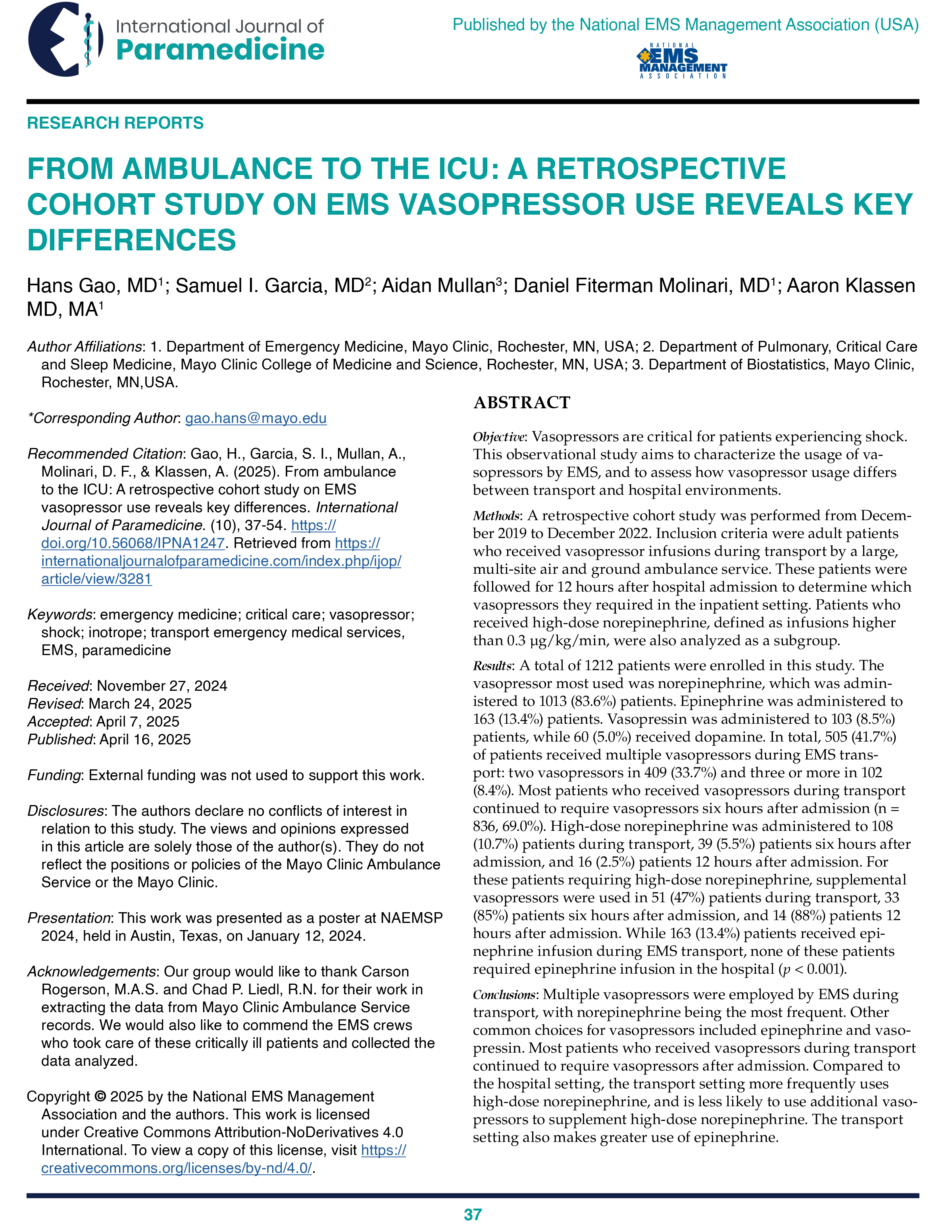
OBJECTIVE: Vasopressors are critical for patients experiencing shock. This observational study aims to describe the usage of vasopressors by EMS, and to assess how vasopressor usage differs between transport and hospital environments. The information gathered in this study can help determine which vasopressors should be available in an EMS system and guide the management of patients requiring vasopressors during EMS transport.
METHODS: A retrospective observation study was performed from December 2019 to December 2022. Inclusion criteria were adult patients who received vasopressor infusions during transport by the Mayo Clinic Ambulance Service. These patients were followed up to 12 hours after hospital admission to determine which vasopressors they received after hospital admission.
RESULTS: A total of 1212 patients were enrolled in this study. The vasopressor most used was norepinephrine, which was administered to 1081 (89.2%) patients. Epinephrine was administered to 163 (13.4%) patients. Vasopressin was administered to 103 (8.5%) patients, while 60 (5.0%) received dopamine. In total, 505 (41.7%) of patients received multiple vasopressors during EMS transport. Most patients who received vasopressors during transport continued to require vasopressors six hours after admission (n = 836, 69.0%). High-dose norepinephrine, defined as infusions higher than 0.3 μg/kg/min, was administered to 108 (10.7%) patients during transport, 39 (5.5%) patients six hours after admission, and 16 (2.5%) patients 12 hours after admission. For these patients requiring high-dose norepinephrine, supplemental vasopressors were used in 51 (47%) patients during transport, 33 (85%) patients six hours after admission, and 14 (88%) patients 12 hours after admission.
Article Details

This work is licensed under a Creative Commons Attribution-NoDerivatives 4.0 International License.
Publishing in IJOP allows authors to keep their copyright while giving IJOP unrestricted copyright permissions. Articles published in IJOP use Creative Common Attribution 4.0 International (CC BY-ND 4.0) licensing. This license requires that re-users give credit to the creator. It allows re-users to copy and distribute the material in any medium or format in unadapted form only, even for commercial purposes. Additional terms apply and can be accessed here.
Publishing in IJOP also allows authors to have contracts for non-exclusive distribution of the Journal's published version of the article, such as posting to an institutional repository or publication in a book, on the condition that the original publication in the original layout format in IJOP is retained and acknowledged.
We permit and encourage authors to post the articles they published in IJOP on their affiliated websites. This helps share the information, encourages citation in other works, and promotes scholarly discourse in the spirit of open access.
References
Abraham, W. T., Adams, K. F., Fonarow, G. C., Costanzo, M. R., Berkowitz, R. L., LeJemtel, T. H., Cheng, M. L., Wynne, J., Committee, A. S. A., Investigators, & Group, A. S. (2005). In-hospital mortality in patients with acute decompensated heart failure requiring intravenous vasoactive medications: an analysis from the Acute Decompensated Heart Failure National Registry (ADHERE). J Am Coll Cardiol, 46(1), 57-64. https://doi.org/10.1016/j.jacc.2005.03.051
Araiza, A., Duran, M., & Varon, J. (2022). Administration of vasopressors through peripheral venous catheters. CMAJ, 194(21), E739. https://doi.org/10.1503/cmaj.211966
Avni, T., Lador, A., Lev, S., Leibovici, L., Paul, M., & Grossman, A. (2015). Vasopressors for the Treatment of Septic Shock: Systematic Review and Meta-Analysis. PLoS One, 10(8), e0129305. https://doi.org/10.1371/journal.pone.0129305
Baran, D. A., Grines, C. L., Bailey, S., Burkhoff, D., Hall, S. A., Henry, T. D., Hollenberg, S. M., Kapur, N. K., O'Neill, W., Ornato, J. P., Stelling, K., Thiele, H., van Diepen, S., & Naidu, S. S. (2019). SCAI clinical expert consensus statement on the classification of cardiogenic shock: This document was endorsed by the American College of Cardiology (ACC), the American Heart Association (AHA), the Society of Critical Care Medicine (SCCM), and the Society of Thoracic Surgeons (STS) in April 2019. Catheter Cardiovasc Interv, 94(1), 29-37. https://doi.org/10.1002/ccd.28329
Bloom, J. E., Andrew, E., Dawson, L. P., Nehme, Z., Stephenson, M., Anderson, D., Fernando, H., Noaman, S., Cox, S., Milne, C., Chan, W., Kaye, D. M., Smith, K., & Stub, D. (2022). Incidence and Outcomes of Nontraumatic Shock in Adults Using Emergency Medical Services in Victoria, Australia. JAMA Netw Open, 5(1), e2145179. https://doi.org/10.1001/jamanetworkopen.2021.45179
Brown, J. C., Simons, E., & Rudders, S. A. (2020). Epinephrine in the Management of Anaphylaxis. J Allergy Clin Immunol Pract, 8(4), 1186-1195. https://doi.org/10.1016/j.jaip.2019.12.015
Campbell, R. L., Li, J. T., Nicklas, R. A., Sadosty, A. T., Members of the Joint Task, F., & Practice Parameter, W. (2014). Emergency department diagnosis and treatment of anaphylaxis: a practice parameter. Ann Allergy Asthma Immunol, 113(6), 599-608. https://doi.org/10.1016/j.anai.2014.10.007
Chen, J. T., Roberts, R., Fazzari, M. J., Kashani, K., Qadir, N., Cairns, C. B., Mathews, K., Park, P., Khan, A., Gilmore, J. F., Brown, A. R. T., Tsuei, B., Handzel, M., Lee Chang, A., Duggal, A., Lanspa, M., Herbert, J. T., Martinez, A., Tonna, J., . . . Society of Critical Care Medicine Discovery, N. (2020). Variation in Fluid and Vasopressor Use in Shock With and Without Physiologic Assessment: A Multicenter Observational Study. Crit Care Med, 48(10), 1436-1444. https://doi.org/10.1097/CCM.0000000000004429
Cuffe, M. S., Califf, R. M., Adams, K. F., Jr., Benza, R., Bourge, R., Colucci, W. S., Massie, B. M., O'Connor, C. M., Pina, I., Quigg, R., Silver, M. A., Gheorghiade, M., & Outcomes of a Prospective Trial of Intravenous Milrinone for Exacerbations of Chronic Heart Failure, I. (2002). Short-term intravenous milrinone for acute exacerbation of chronic heart failure: a randomized controlled trial. JAMA, 287(12), 1541-1547. https://doi.org/10.1001/jama.287.12.1541
De Backer, D., Biston, P., Devriendt, J., Madl, C., Chochrad, D., Aldecoa, C., Brasseur, A., Defrance, P., Gottignies, P., Vincent, J. L., & Investigators, S. I. (2010). Comparison of dopamine and norepinephrine in the treatment of shock. N Engl J Med, 362(9), 779-789. https://doi.org/10.1056/NEJMoa0907118
Dellinger, R. P., Levy, M. M., Rhodes, A., Annane, D., Gerlach, H., Opal, S. M., Sevransky, J. E., Sprung, C. L., Douglas, I. S., Jaeschke, R., Osborn, T. M., Nunnally, M. E., Townsend, S. R., Reinhart, K., Kleinpell, R. M., Angus, D. C., Deutschman, C. S., Machado, F. R., Rubenfeld, G. D., . . . Surviving Sepsis Campaign Guidelines Committee including the Pediatric, S. (2013). Surviving sepsis campaign: international guidelines for management of severe sepsis and septic shock: 2012. Crit Care Med, 41(2), 580-637. https://doi.org/10.1097/CCM.0b013e31827e83af
Domizi, R., Calcinaro, S., Harris, S., Beilstein, C., Boerma, C., Chiche, J. D., D'Egidio, A., Damiani, E., Donati, A., Koetsier, P. M., Madden, M. P., McAuley, D. F., Morelli, A., Pelaia, P., Royer, P., Shankar-Hari, M., Wickboldt, N., Zolfaghari, P., & Singer, M. (2020). Relationship between norepinephrine dose, tachycardia and outcome in septic shock: A multicentre evaluation. J Crit Care, 57, 185-190. https://doi.org/10.1016/j.jcrc.2020.02.014
Ducrocq, N., Kimmoun, A., Furmaniuk, A., Hekalo, Z., Maskali, F., Poussier, S., Marie, P. Y., & Levy, B. (2012). Comparison of equipressor doses of norepinephrine, epinephrine, and phenylephrine on septic myocardial dysfunction. Anesthesiology, 116(5), 1083-1091. https://doi.org/10.1097/ALN.0b013e31824f9669
Evans, L., Rhodes, A., Alhazzani, W., Antonelli, M., Coopersmith, C. M., French, C., Machado, F. R., McIntyre, L., Ostermann, M., Prescott, H. C., Schorr, C., Simpson, S., Wiersinga, W. J., Alshamsi, F., Angus, D. C., Arabi, Y., Azevedo, L., Beale, R., Beilman, G., . . . Levy, M. (2021). Surviving Sepsis Campaign: International Guidelines for Management of Sepsis and Septic Shock 2021. Crit Care Med, 49(11), e1063-e1143. https://doi.org/10.1097/CCM.0000000000005337
Feldman, R., Stanton, M., Chinn, M., Grawey, T., & Weston, B. (2020). Choosing a Vasopressor for a Prehospital Emergency Medical System: Consideration for Agent Selection and Review of Pharmacologic Profiles, Efficacy, and Safety in Treatment of Shock. WMJ, 119(4), 240-247. https://www.ncbi.nlm.nih.gov/pubmed/33428833
Fujizuka, K., Nakamura, M., Tamura, J., & Kawai-Kowase, K. (2022). Comparison of the efficacy of continuous intravenous infusion versus intramuscular injection of epinephrine for initial anaphylaxis treatment. Acute Med Surg, 9(1), e790. https://doi.org/10.1002/ams2.790
Gaviria-Mendoza, A., Machado-Alba, J. E., Benítez-Mejía, J. F., Correa-Ruiz, S., Restrepo-López, J. S., Moreno-Gutiérrez, P. A., & Gómez-González, J. F. (2021). Trends of vasopressor use in intensive care units in Colombia. Colombian Journal of Anesthesiology, 49(4). https://doi.org/10.5554/22562087.e996
Inoue, T., Manley, G. T., Patel, N., & Whetstone, W. D. (2014). Medical and surgical management after spinal cord injury: vasopressor usage, early surgerys, and complications. J Neurotrauma, 31(3), 284-291. https://doi.org/10.1089/neu.2013.3061
Jentzer, J. C., Wiley, B., Bennett, C., Murphree, D. H., Keegan, M. T., Kashani, K. B., Bell, M. R., & Barsness, G. W. (2020). Temporal Trends and Clinical Outcomes Associated with Vasopressor and Inotrope Use in The Cardiac Intensive Care Unit. Shock, 53(4), 452-459. https://doi.org/10.1097/SHK.0000000000001390
Jones, A. E., Stiell, I. G., Nesbitt, L. P., Spaite, D. W., Hasan, N., Watts, B. A., & Kline, J. A. (2004). Nontraumatic out-of-hospital hypotension predicts inhospital mortality. Ann Emerg Med, 43(1), 106-113. https://doi.org/10.1016/j.annemergmed.2003.08.008
Jouffroy, R., Hajjar, A., Gilbert, B., Tourtier, J. P., Bloch-Laine, E., Ecollan, P., Boularan, J., Bounes, V., Vivien, B., & Gueye, P. N. (2022). Prehospital norepinephrine administration reduces 30-day mortality among septic shock patients. BMC Infect Dis, 22(1), 345. https://doi.org/10.1186/s12879-022-07337-y
Kahn, J. M., Kress, J. P., & Hall, J. B. (2002). Skin necrosis after extravasation of low-dose vasopressin administered for septic shock. Crit Care Med, 30(8), 1899-1901. https://doi.org/10.1097/00003246-200208000-00038
Lee, S. Y., Lee, S. C., Shin, S. D., Song, K. J., Ro, Y. S., Park, J. H., & Kong, S. Y. (2018). Epidemiology and outcomes of anaphylaxis-associated out-of-hospital cardiac arrest. PLoS One, 13(3), e0194921. https://doi.org/10.1371/journal.pone.0194921
Levy, B., Clere-Jehl, R., Legras, A., Morichau-Beauchant, T., Leone, M., Frederique, G., Quenot, J. P., Kimmoun, A., Cariou, A., Lassus, J., Harjola, V. P., Meziani, F., Louis, G., Rossignol, P., Duarte, K., Girerd, N., Mebazaa, A., Vignon, P., & Collaborators. (2018). Epinephrine Versus Norepinephrine for Cardiogenic Shock After Acute Myocardial Infarction. J Am Coll Cardiol, 72(2), 173-182. https://doi.org/10.1016/j.jacc.2018.04.051
Lewis, T., Merchan, C., Altshuler, D., & Papadopoulos, J. (2019). Safety of the Peripheral Administration of Vasopressor Agents. J Intensive Care Med, 34(1), 26-33. https://doi.org/10.1177/0885066616686035
Lokesh, L., Fowler, R. L., Augustine, J. J., & Cabanas, J. G. (2018). Variabilities in the use of IV epinephrine in the management of cardiac arrest patients. J Emerg Med Serv(43), 1-5. https://www.jems.com/2018/10/15/variabilities-in-the-use-of-iv-epinephrine-in-the-management-of-cardiac-arrest-patients
Mathew, R., Di Santo, P., Jung, R. G., Marbach, J. A., Hutson, J., Simard, T., Ramirez, F. D., Harnett, D. T., Merdad, A., Almufleh, A., Weng, W., Abdel-Razek, O., Fernando, S. M., Kyeremanteng, K., Bernick, J., Wells, G. A., Chan, V., Froeschl, M., Labinaz, M., . . . Hibbert, B. (2021). Milrinone as Compared with Dobutamine in the Treatment of Cardiogenic Shock. N Engl J Med, 385(6), 516-525. https://doi.org/10.1056/NEJMoa2026845
McIntyre, W. F., Um, K. J., Alhazzani, W., Lengyel, A. P., Hajjar, L., Gordon, A. C., Lamontagne, F., Healey, J. S., Whitlock, R. P., & Belley-Cote, E. P. (2018). Association of Vasopressin Plus Catecholamine Vasopressors vs Catecholamines Alone With Atrial Fibrillation in Patients With Distributive Shock: A Systematic Review and Meta-analysis. JAMA, 319(18), 1889-1900. https://doi.org/10.1001/jama.2018.4528
Menich, B. E., Miano, T. A., Patel, G. P., & Hammond, D. A. (2019). Norepinephrine and Vasopressin Compared With Norepinephrine and Epinephrine in Adults With Septic Shock. Ann Pharmacother, 53(9), 877-885. https://doi.org/10.1177/1060028019843664
Munroe, E., Claar, D., Tamae-Kakazu, M., Tatem, G., Blamoun, J., McSparron, J. I., & Prescott, H. C. (2022). Hospital Policies on Intravenous Vasopressor Administration and Monitoring: A Survey of Michigan Hospitals. Ann Am Thorac Soc, 19(10), 1769-1772. https://doi.org/10.1513/AnnalsATS.202203-197RL
Nagendran, M., Russell, J. A., Walley, K. R., Brett, S. J., Perkins, G. D., Hajjar, L., Mason, A. J., Ashby, D., & Gordon, A. C. (2019). Vasopressin in septic shock: an individual patient data meta-analysis of randomised controlled trials. Intensive Care Med, 45(6), 844-855. https://doi.org/10.1007/s00134-019-05620-2
O'Gara, P. T., Kushner, F. G., Ascheim, D. D., Casey, D. E., Jr., Chung, M. K., de Lemos, J. A., Ettinger, S. M., Fang, J. C., Fesmire, F. M., Franklin, B. A., Granger, C. B., Krumholz, H. M., Linderbaum, J. A., Morrow, D. A., Newby, L. K., Ornato, J. P., Ou, N., Radford, M. J., Tamis-Holland, J. E., . . . American College of Cardiology Foundation/American Heart Association Task Force on Practice, G. (2013). 2013 ACCF/AHA guideline for the management of ST-elevation myocardial infarction: a report of the American College of Cardiology Foundation/American Heart Association Task Force on Practice Guidelines. Circulation, 127(4), e362-425. https://doi.org/10.1161/CIR.0b013e3182742cf6
Petersen, J. W., & Felker, G. M. (2008). Inotropes in the management of acute heart failure. Crit Care Med, 36(1 Suppl), S106-111. https://doi.org/10.1097/01.CCM.0000296273.72952.39
Pfizer. (2022). Levophed - New Zealand Data Sheet.
Poloujadoff, M. P., Lapostolle, F., Lockey, D., Amathieu, R., Merouani, M., Galinski, M., & Adnet, F. (2006). Survival of severely shocked patients who present with absent radial pulse and unrecordable blood pressure in the pre-hospital phase. Resuscitation, 69(2), 185-189. https://doi.org/10.1016/j.resuscitation.2005.08.016
Quinn, E., Su, J., Fei, L., Liu, J., Friedman, M., Lobel, D., Kabiriti, S., Likourezos, A., Motov, S., & Eng, D. (2022). Perceptions and Barriers to Administering Vasopressors in the Prehospital Setting. Cureus, 14(9), e29614. https://doi.org/10.7759/cureus.29614
Raynovich, W., Hums, J., Stuhlmiller, D. F., Bramble, J. D., Kasha, T., & Galt, K. (2013). Critical care transportation by paramedics: a cross-sectional survey. Air Med J, 32(5), 280-288. https://doi.org/10.1016/j.amj.2013.05.008
Readdy, W. J., Whetstone, W. D., Ferguson, A. R., Talbott, J. F., Inoue, T., Saigal, R., Bresnahan, J. C., Beattie, M. S., Pan, J. Z., Manley, G. T., & Dhall, S. S. (2015). Complications and outcomes of vasopressor usage in acute traumatic central cord syndrome. J Neurosurg Spine, 23(5), 574-580. https://doi.org/10.3171/2015.2.SPINE14746
Mayo Clinic Enterprise IVAG Workgroup. (2022). Peripheral Intravenous Administration of Vasopressor Therapy Prescribing and Safe Use Guidelines: A Quality Improvement Initiative at RST and NWWI.
Mayo Clinic Process/Medical Direction Committee. (2023). Ambulance Service Patient Care Guidelines. https://intranet.mayo.edu/charlie/ambulance-service-fla/files/2023/05/Dec-22-guidelines-2.pdf
Rivosecchi, R., Collier, V., Barbash, I., Boeltz, A., Wang, S., Guo, X., Suh, K., Donadee, C., & Horvat, C. (2024). 938: VASOPRESSIN UTILIZATION TRENDS AND COST ANALYSIS IN SEPTIC SHOCK PATIENTS. Critical Care Medicine, 52(1), S441. https://doi.org/10.1097/01.ccm.0001001916.52399.cf
Sizemore, S., Patel, M. V. B., Carter, B., & Garrett, E. (2022). Adjusting vasopressin availability and formulation: A cost-savings initiative. Am J Health Syst Pharm, 79(Suppl 3), S74-S78. https://doi.org/10.1093/ajhp/zxac142
Smida, T., Crowe, R. P., Martin, P. S., Scheidler, J. F., Price, B. S., & Bardes, J. M. (2024). A retrospective, multi-agency 'target trial emulation' for the comparison of post-resuscitation epinephrine to norepinephrine. Resuscitation, 198, 110201. https://doi.org/10.1016/j.resuscitation.2024.110201
Thiele, R. H., Nemergut, E. C., & Lynch, C., 3rd. (2011). The clinical implications of isolated alpha(1) adrenergic stimulation. Anesth Analg, 113(2), 297-304. https://doi.org/10.1213/ANE.0b013e3182120ca5
Thongprayoon, C., Cheungpasitporn, W., Harrison, A. M., Carrera, P., Srivali, N., Kittamongkolchai, W., Erdogan, A., & Kashani, K. B. (2016). Temporal trends in the utilization of vasopressors in intensive care units: an epidemiologic study. BMC Pharmacol Toxicol, 17(1), 19. https://doi.org/10.1186/s40360-016-0063-z
Tian, D. H., Smyth, C., Keijzers, G., Macdonald, S. P., Peake, S., Udy, A., & Delaney, A. (2020). Safety of peripheral administration of vasopressor medications: A systematic review. Emerg Med Australas, 32(2), 220-227. https://doi.org/10.1111/1742-6723.13406
V3 EMS Data Cube. https://nemsis.org/view-reports/public-reports/ems-data-cube/
van Diepen, S., Katz, J. N., Albert, N. M., Henry, T. D., Jacobs, A. K., Kapur, N. K., Kilic, A., Menon, V., Ohman, E. M., Sweitzer, N. K., Thiele, H., Washam, J. B., Cohen, M. G., American Heart Association Council on Clinical, C., Council on, C., Stroke, N., Council on Quality of, C., Outcomes, R., & Mission, L. (2017). Contemporary Management of Cardiogenic Shock: A Scientific Statement From the American Heart Association. Circulation, 136(16), e232-e268. https://doi.org/10.1161/CIR.0000000000000525
Vincent, J. L., & De Backer, D. (2013). Circulatory shock. N Engl J Med, 369(18), 1726-1734. https://doi.org/10.1056/NEJMra1208943
Wang, H. E., Shapiro, N. I., & Yealy, D. M. (2011). Characteristics of out-of-hospital shock care. Crit Care Med, 39(11), 2431-2439. https://doi.org/10.1097/CCM.0b013e3182257310